POSI self-audit
The Principles of Open Scholarly Infrastructure (POSI) are a set of community-based principles that open scholarly infrastructure organisations and initiatives that support the research community can be guided by and adhere to. POSI encourages open scholarly infrastructures to complete a self-assessment against the Principles. OAPEN and DOAB are separate but interconnected infrastructures for open access books. As such, they have different governance and we carry out a self-audit for each. We hope you agree that seeing the two self-audits side-by-side helps to compare and contrast the ways they operate.
Reaffirming our commitment to the Principles of Open Scholarly Infrastructure (POSI)
Introduction to the 2025 POSI self-assessment
In May 2023, we performed the first POSI (Principles of Open Scholarly Infrastructure) self-assessment of OAPEN & DOAB. We publicised our self-assessment on the POSI Adopters page.
Since then, POSI has been updated. In October 2025 POSI version 2.0 was released. This updated version is based on community consultation and a good deal of discussion and work performed by the POSI adopters.
At OAPEN & DOAB we have been looking forward to the new and updated version which introduces several changes compared to version 1.1 and a few new principles. There are now 20 principles in total. The release of version 2.0 prompted us to reassess ourselves against the principles. Below you will find our reassessment.
First, we provide an overview of the principles and our self-assessment in 2023 and 2025 indicated by using a traffic-light system where red indicates that we are not fulfilling the principle; orange indicates we are making progress towards meeting the principle; and green indicates we are fulfilling the principle. Second, we provide reassessment comments on each of the principles.
Should you be interested in knowing more, or do you have questions or comments, we would love to hear from you. Please send an email to info [@] oapen.org.
Summary of the 2025 POSI reassessment of OAPEN and DOAB
| OAPEN 2023 | OAPEN 2025 | DOAB 2023 | DOAB 2025 | |
|---|---|---|---|---|
| Governance | ||||
| Coverage across the scholarly enterprise |  (Green) (Green) | (Green) | (Green) | (Green) |
| Stakeholder governed | (Green) | (Green) | (Green) | (Green) |
| Non-discriminatory participation or membership | (Green) | (Green) | (Green) | (Green) |
| Transparent governance (CHANGED) | (Green) | (Green) | (Green) | (Green) |
| Cannot lobby | (Green) | (Green) | (Green) | (Green) |
| Living will |  (Orange) (Orange) | (Green) | (Orange) | (Orange) |
| Regular review of purpose and community value (CHANGED/ NEW) | (Green) | (Green) | (Green) | (Green) |
| Sustainability | ||||
| Transparent operations (NEW) | N/A | (Orange) | N/A | (Orange) |
| Time-limited funds are used only for time-limited activities | (Green) | (Green) | (Green) | (Green) |
| Goal to generate surplus | (Orange) | (Green) | (Orange) | (Green) |
| Establish and maintain financial reserves guided by policy | (Orange) | (Orange) | (Orange) | (Orange) |
| Mission-consistent revenue generation | (Green) | (Green) | (Green) | (Green) |
| Revenue generated from services, not data | (Green) | (Green) | (Green) | (Green) |
| Volunteer labour (NEW) | N/A | (Green) | N/A | (Green) |
| Transition planning (NEW) | N/A | (Orange) | N/A | (Orange) |
| Insurance | ||||
| Open Source | (Green) | (Green) | (Green) | (Green) |
| Ensure open and secure data accessibility within legal and ethical constraints | (Green) | (Green) | (Green) | (Green) |
| Available and preserved | (Green) | (Green) | (Green) | (Green) |
| Patent non-assertion | (Green) | (Green) | (Green) | (Green) |
| Prioritise interoperability and open standards to ensure continuity and resilience (NEW) | N/A | (Orange) | N/A | (Orange) |
2025 self-assessment comments
The OAPEN Foundation (established in 2011) and the DOAB Foundation (established in 2019) are both independent, not-for-profit Dutch foundations (‘Stichting’) registered at the National Library in The Hague and dedicated to supporting open access (OA), peer‑reviewed scholarly books.
Although two separate organisations with their own governing boards, the OAPEN Foundation team manages both infrastructures. In most – if not all – aspects relating to POSI the two foundations share characteristics. It therefore makes sense to assess them jointly as we also did in 2023. However, wherever there are differences, these are highlighted.
Governance
Coverage across the scholarly enterprise (green)
OAPEN & DOAB continues to support the scholarly enterprise at global scale. The infrastructures continue to be available for peer-reviewed open access (OA) books across geographies and disciplines with a strong commitment to bibliodiversity, multi-lingualism, and cultural diversity. Since the 2023 audit, OAPEN & DOAB have proactively reached audiences in Africa, the Middle East, and Asia through project engagements, conference participation, workshops, its newly set-up Ambassador Programme, and via direct contacts. These efforts will be maintained in the coming months and years, while remaining available to publishers and partners of all shapes and sizes from across the world as long as they comply with our admission criteria. These criteria have not changed but have been clarified and made more transparent, see here for example on the DOAB website. We continue to support stakeholders relevant to OA book publishing, such as publishers, libraries, funders, and researchers. However, over the past year we have also increasingly engaged with policymakers, learned societies, and national platforms for Diamond OA publishing. Moreover, we are members of AEUP, OASPA, and a founding and core member of OPERAS.
Stakeholder governed (green)
Since the 2023 POSI self-audit OAPEN has changed its governance structure and made its Articles of Association publically available. The OAPEN Supervisory Board and Advisory Board comprise members from different stakeholder groups and geographical regions (see OAPEN Board members and organogram). The selection process for the representatives to the OAPEN governing bodies is explained in the Articles of Association. For the general management of the organisation the Executive Director was changed to a Managing Director (in effect the Board of Directors). At our annual meeting for supporting libraries we continue to provide opportunities for stakeholders to give their direct feedback on our operations including our technical roadmap.
DOAB is still governed by an Executive Board, a Supervisory Board, and the DOAB Scientific Committee, and the DOAB Community of Supporting Libraries (see About DOAB).
The OAPEN Foundation and DOAB are both Dutch Stichtings, which means that they can’t be sold or acquired – see this blog post for more information.
Non-discriminatory participation or membership (green)
This principle is not applicable to us since OAPEN & DOAB are not membership associations. However, we remain open and inclusive to publishers of all languages, disciplines and geographies that meet our requirements. Furthermore, our Boards have broad stakeholder representation (libraries, funders, publishers, infrastructure providers, policymakers).
Transparent governance (green)
The governance of OAPEN & DOAB is explained in the Articles of Association. These articles are publicly available via the Dutch Chamber of Commerce and also via our websites: OAPEN Articles of Association and DOAB Articles of Association.
Cannot lobby (green)
We’re a mission-driven organisation, and part of our mission is to promote open access to books. We distinguish between lobbying (seeking legal or financial changes that directly benefit us) and advocacy (professional influence in support of our organisational mission). We aim to be professional advocates by bringing our expertise and ethical stance to community debates about open access books.In this way, we contribute to community discussions and support the implementation of policies decided by the community. As an example, we co-coordinated the EU-funded policy-focused project PALOMERA (2023-2024) which produced a set of policy recommendations to all relevant stakeholders engaged in open access and scholarly books. These recommendations are based on extensive research across 39 countries in the European research area and have been consulted with and validated by relevant communities. We promote and advocate these recommendations. For example, we have set up a Policy Forum on OA Books together with Science Europe and cOAlition S with the intention of supporting research funders and other policymakers based on the PALOMERA recommendations.
Living will (green / orange)
Since the 2023 audit, OAPEN has entered a Memorandum of Understanding (MoU) with the Koninklijke Bibliotheek, National Library of the Netherlands (KB) describing the role of the KB in the living will of OAPEN. The MoU records the mutual understanding between the parties regarding contingency arrangements for the transfer of the OAPEN Library’s publications to the KB. In the event that the OAPEN Library ceases to exist or permanently discontinues its core activities, the KB agrees to preserve and provide continued open access to the publications in the OAPEN Library. OAPEN and the KB will, as early as reasonably possible and prior to any winding down, jointly develop a documented transfer and preservation plan, covering technical, legal, and metadata-related aspects, to be activated upon the dissolution of OAPEN. The development of a living will for DOAB is planned for 2026.
Regular review of purpose and community value (green)
We are regularly reviewing our purpose and community value in a number of ways. Our strategic plans have been developed in close collaboration with the stakeholders represented in our boards. We review the annual work plans with the Boards to ensure alignment between strategy and activities. We also engage with stakeholders at conferences and in online events and meetings (see recent list of conference attendance). Talking at events globally emphasises that we are not only seen as a European initiative but considered as a globally relevant infrastructure provider. Moreover, we invite stakeholders to share their views and opinions on our work, e.g. at our annual meeting for supporting libraries.In 2025, we commissioned an external technical review of our infrastructures. This was performed by the Curtin University Institute of Data Science who interviewed key partners about their relationship and interoperability with OAPEN & DOAB, replicated the code base, provided additional documentation, and delivered a number of recommendations for technical development..
We interpret the growing number of invitations to project consortia as a sign of continued relevance in the community. We also see our partnership agreement (entered 2024) with CERN (providing server hosting and maintenance) as proof of our continued relevance just as our newly signed agreement with KNAW Humanities Cluster (part of the Royal Netherlands Academy of Arts and Sciences) about establishing a Dutch OPERAS national node as a recognition of our relevance in the research landscape.
Sustainability
Transparent operations (new principle) (orange)
OAPEN & DOAB are fully committed to providing as much transparency to our operations as possible. Our operating policies and procedures are described in the Articles of Association but also in the OAPEN Strategic Plan 2025-2028 and the DOAB Strategic Plan 2025-2028. Our DOAB library supporter contribution tiers and our OAPEN library supporter contribution tiers are clearly described and so are the publisher sponsorship levels for DOAB and the publisher pricing for OAPEN. We share our annual financial results (and other achievements) in our annual reports. We make our OAPEN organisational chart and members of our boards publicly available just like the members of the DOAB Boards and Scientific Committee.
However, we think we can still improve in the area of transparency and therefore we have marked this principle only as orange. For example, we plan to update and clarify our fee structures in the coming year and we want to share our technical roadmap more transparently.
Time-limited funds are used only for time-limited activities (green)
Our day-to-day operations are supported by revenues from supporting libraries, service fees (publishers and research funders), private donations, and sponsorships. Project funds are used to support project work and pay the salaries of those who perform the project related tasks.
Goal to generate surplus (green)
We have upgraded this principle from orange to green because we have been able to generate a surplus every year for the past five years. However, this could easily change as the majority of our revenue is received as investments from academic libraries and consortia who already have access to metadata and the publications for free. Generating a surplus remains important and a strategic objective to ensure the ability to develop and innovate our infrastructures. We will continue to explore new mission-aligned revenue sources to grow and diversify our income in order to be less vulnerable to fluctuations in library budgets.
Establish and maintain financial reserves guided by policy (orange)
Our aim is to have a contingency fund in place that can cover the costs of operating the infrastructures sufficiently long to secure an orderly wind-down – if that should ever become necessary. The level of the contingency fund is evaluated annually by the Boards. Therefore, the Boards appropriate a possible surplus according to the contingency fund in line with their evaluation. It’s the current objective of the Boards that we should still increase the contingency funds (to cover at least 12 months of operating costs) and therefore we are still marking this principle orange.
Mission-consistent revenue generation (green)
Our mission is to sustain and evolve the OAPEN Library and to curate DOAB as a global, open, and trusted index of open scholarly books. We serve a diverse set of stakeholders including publishers, libraries, research funders, and researchers, with the ultimate goal of advancing open access for the public good. Our revenue sources (supporter fees, service fees from publishers and funders, sponsorships, and donations) are consistent with this mission. Any potential additional revenue sources are considered for consistency with the organisational mission by the Executive and Supervisory Boards of OAPEN and DOAB. There is no relationship between payments of any sort and governance roles.
Revenue generated from services, not data (green)
Our metadata are openly (CC0) available in a variety of formats, including .csv and via our REST API (see Metadata for Libraries and Aggregators). We raise revenue from services only, not access to data.
Volunteer labour (new principle) (green)
OAPEN & DOAB do not make use of volunteer labour for its operations and therefore this principle is not applicable. However, we have recently initiated an Ambassador Programme where the ambassadors are volunteers. While this support to OAPEN & DOAB is very valuable it is not critical to the operation of the infrastructure. The members of our governing boards are performing their roles pro bono. Yet, this does not affect our sustainability planning or risk management.
Transition planning (new principle) (orange)
Over the past five years the OAPEN & DOAB team has grown and the organisation has matured and professionalised. This includes a process of implementing tools for knowledge sharing and collaboration like a CRM system, co-working space, HR and financial systems, and other systems for knowledge sharing. Well-organised knowledge sharing systems and documentation procedures like the ones we have implemented for OAPEN & DOAB mitigate the risk of the organisation’s dependency on individuals. Therefore, we mark this principle green. However, we acknowledge that we must always keep improving and refining our internal procedures for knowledge sharing and documentation. In this way, any individual leaving the organisation would do so without major disruption and new staff could be onboarded efficiently.
Insurance
Open Source (green)
OAPEN & DOAB run on DSpace (open source repository software) and our servers are hosted in the CERN Data Centre. For our websites, we use Strapi CMS (open source). We commit to continuing to run our infrastructures on open source applications. Ensure open and secure data accessibility within legal and ethical constraints (green) OAPEN & DOAB metadata are available under a public domain dedication (CC0). The publications hosted in the OAPEN Library are made available with the licences provided by the publisher. We monitor and share the distribution of licences in the OAPEN Library, e.g. for 2024:
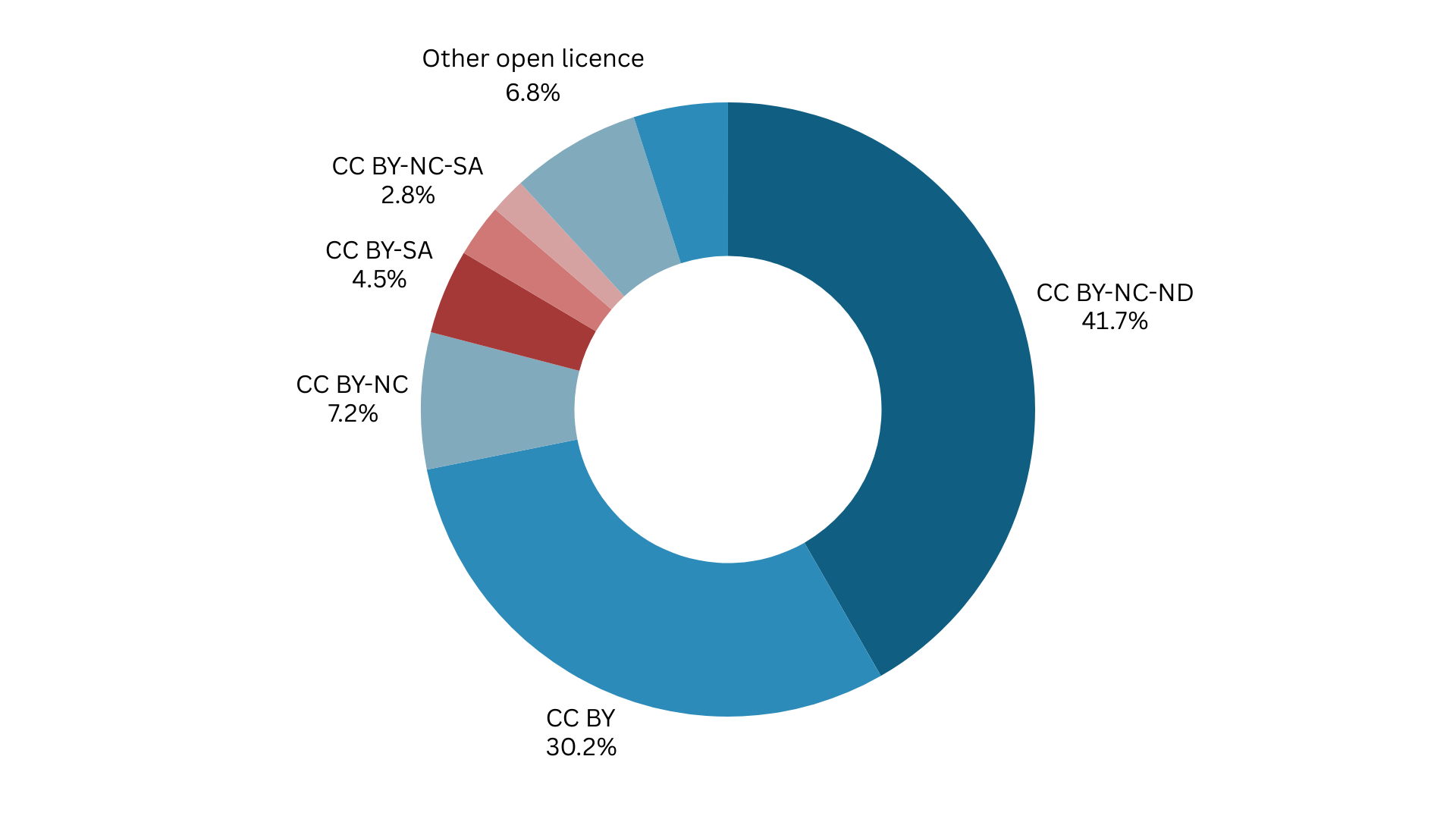
Unless noted otherwise, all content on the OAPEN & DOAB websites is available under a CC BY 4.0 licence. This has been implemented since the first assessment in 2023.
We also provide accessibility statements: the OAPEN accessibility statement and the DOAB accessibility statement.
Available and preserved (green)
The OAPEN & DOAB APIs are open and well-documented alongside the metadata provided in different formats, including MARCXML (MARC 21 enabled by Penn State University Library based on OAPEN records), KBART, ONIX, JSON, CSV, RIS, and open to OAI-PMH harvesting and also provide RSS and Atom feeds. The REST API and metadata feeds descriptions for OAPEN and REST API and metadata feeds descriptions for DOAB.
Furthermore, thousands of libraries and other discovery systems integrate our metadata (and the full texts) in their systems ensuring longevity of the existing corpus of over 40,000 titles in OAPEN and over 100,000 metadata records in DOAB. Finally, publications hosted in the OAPEN Library are sent to Portico for long-term preservation and we also work with CLOCKSS.
Patent non-assertion (green)
Our open source way of working means that our work is in the public domain and therefore not suitable for patenting. However, we want to emphasise that we commit to not patent any part of our operations that would prevent the community from replicating our infrastructure. Prioritise interoperability and open standards to ensure continuity and resilience (new principle) (orange) We are delighted to see that our suggestion to include interoperability as a principle in POSI has been adopted. Interoperability is a key element of sustainability and insurance, without which an organisation risks its useful role and could possibly have to wind down.
At OAPEN & DOAB we base our work on open standards - wherever possible. As mentioned above, all our metadata are based on open standards. We also strongly promote the use of standard persistent identifiers like DOI, ORCID, and ROR or equivalent.
In 2025, we commissioned an external technical review of our infrastructures with the intention of testing and improving interoperability. This was performed by the Curtin University Institute of Data Science who interviewed key partners about their relationship and interoperability with OAPEN & DOAB, replicated the code base, provided additional documentation, and delivered a number of recommendations for technical development.
We also engage in international fora and committees that promote open standards, like the Barcelona Declaration, NISO, and EDItEUR.
Reference:
POSI Adopters (2025), The Principles of Open Scholarly Infrastructure, retrieved 12-12-2025, https://doi.org/10.14454/G8WV-VM65